
Why the Best Customer Experiences Still Need Humans and AI
Customer Support Isn’t Dead — It’s Evolving: A Decade-Ready Hybrid Approach
Introduction
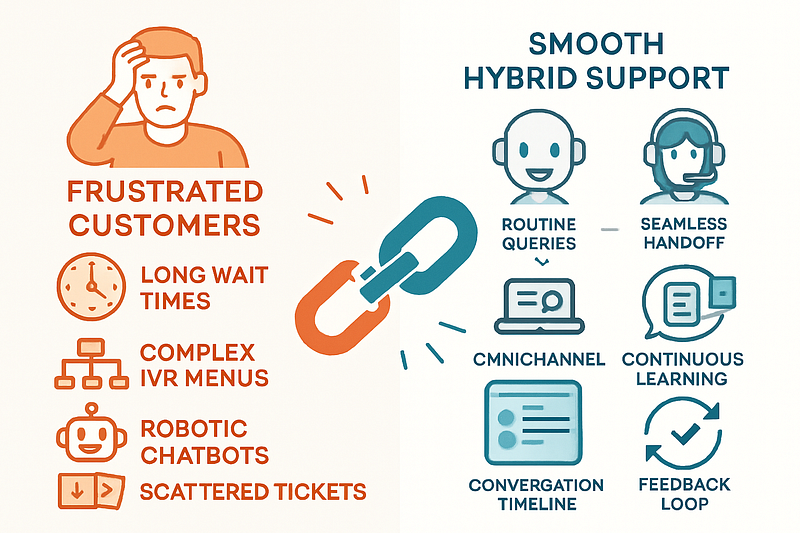
Every one of us—whether a small business owner, a leader in a large organization, or a regular consumer—has experienced poor customer support.
We’ve all:
- Waited in endless queues.
- Navigated confusing IVR menus.
- Chatted with robotic bots.
- Repeated the same issue multiple times.
Yet, despite all the advances in technology, customer support remains one of the biggest frustrations in modern business.
So why does this problem still exist?
More importantly, what would it take to build a customer support model that remains effective not just today, but for the next decade?
In this article, we’ll explore:
- Why customer support continues to fail.
- Why technology alone isn’t enough.
- Whether AI can realistically handle support end-to-end.
- Why a hybrid model remains the most sustainable approach.
- A blueprint for building future-ready customer support operations.
Why Customer Support Still Fails
Even in 2025, many organizations struggle to deliver consistently great customer experiences.
Several common issues continue to appear across industries.
Long Wait Times
Customers often wait more than 20 minutes to reach the right person.
As a result, frustration starts building long before the actual conversation begins.
Automation Without Resolution
IVRs and chatbots frequently act as gatekeepers.
While they reduce operational costs, they often make it harder for customers to reach meaningful support.
Escalation Gaps
Support tickets regularly move between teams without clear ownership.
Consequently, customers lose visibility into who is responsible for solving their problem.
Lack of Empathy
Automated responses may be efficient.
However, they rarely make customers feel understood.
Operational Blind Spots
Many organizations meet internal SLAs on paper.
Yet customer satisfaction remains low because the underlying issue was never truly resolved.
Why Technology Alone Hasn’t Solved the Problem
Many companies have already invested heavily in:
- AI chatbots
- Self-service portals
- Knowledge bases
- Omnichannel support platforms
However, support challenges persist.
This is especially true when:
- Issues become emotionally charged.
- Situations involve financial risk.
- Customers require transparency and reassurance.
- Resolution requires judgment rather than rules.
For example:
- A missed flight
- A failed investment
- A disputed charge
- A delayed medical claim
In these situations, customers don’t just want information.
They want confidence.
And confidence is often difficult to automate.
The Human Side of the Problem
As a Product Manager, I’ve spent years monitoring support metrics:
- SLA compliance
- Escalation rates
- Resolution times
- Customer satisfaction scores
Initially, the dashboards looked healthy.
However, reality told a different story.
I repeatedly observed teams escalating tickets simply to normalize their metrics rather than solve customer problems.
Later, when I became the customer myself—dealing with airlines, banks, and delivery platforms—the disconnect became obvious.
The metrics were improving.
The experience wasn’t.
Why Support Challenges Persist Even as AI Advances
Scale and Complexity
Modern companies serve millions of customers.
As a result, support requests range from simple questions to business-critical emergencies.
Furthermore:
- Product ecosystems are becoming larger.
- Regulations are changing constantly.
- Customer expectations continue to rise.
This complexity makes resolution significantly harder than automation vendors often suggest.
Automation Without Empathy
AI performs exceptionally well with repetitive tasks.
However, empathy remains difficult to replicate.
Customers experiencing stress often need:
- Reassurance
- Context
- Flexibility
- Judgment
These are areas where human support continues to provide unique value.
Misaligned Incentives
Many organizations optimize for:
- Tickets closed
- Average handling time
- SLA compliance
Instead of:
- Problems solved
- Trust restored
- Customer loyalty improved
As a result, teams often chase metrics rather than outcomes.
Can AI Handle Customer Support End-to-End?
For the first time in history, the answer is:
Technically, yes.
Modern AI systems can manage entire support workflows without human involvement.
A fully AI-driven support model would include:
AI Conversational Frontend
Advanced LLMs handling:
- Voice interactions
- Chat interactions
- Intent detection
- Sentiment analysis
Decision and Automation Engine
Automated workflows managing:
- Refunds
- Order updates
- Troubleshooting
- Account changes
Knowledge Graph and RAG Layer
Providing real-time access to:
- Policies
- Documentation
- Historical resolutions
- Product information
Sentiment and Risk Monitoring
Detecting:
- Frustration
- Escalation risk
- Regulatory concerns
- High-impact cases
Continuous Learning Loops
Improving performance through:
- Customer feedback
- New interactions
- Resolution outcomes
As a result, AI can resolve a significant percentage of support requests faster and more consistently than humans.
Example: Reference Architecture
User Channel (Chat/Voice/App)
    ⬇️
NLP/LLM AI Service (Intent/Sentiment/Augmentation)
    ⬇️
Orchestrator & RPA Bots (Business Logic Execution)
    ⬇️
Knowledge Graph/RAG Service (Policy, Product Info, Docs)
    ⬇️
Notification/Status Engine (Proactive Updates)
    ⬇️
Analytics & Auditing Module (Continuous Learning)
Why I Still Believe in the Hybrid Model
Despite these advances, I remain convinced that customer support should not become entirely machine-driven.
Here’s why.
Humans still excel in areas where trust matters most.
For example:
- Medical emergencies
- Lost investments
- Travel disruptions
- Legal disputes
- High-value enterprise relationships
In these moments, customers need more than a technically correct answer.
They need confidence that someone understands their situation and is willing to advocate on their behalf.
Therefore, the future should not be AI versus humans.
Instead, it should be AI and humans working together.
A Future-Proof Customer Support Blueprint
What’s Actually Needed: The Lifelong Solution Blueprint
To build support that stands the test of time — even as AI becomes unimaginably advanced — companies must blend:
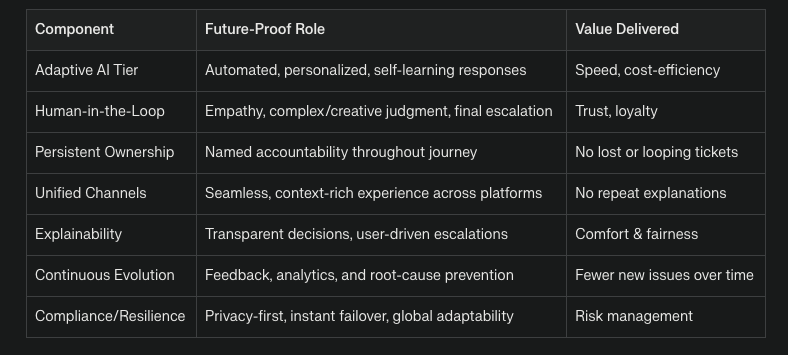
1. AI-First Resolution, Human Judgment When It Matters
- Deploy conversationally fluent, ever-learning AI that resolves the majority of issues instantly and accurately.
- Seamlessly escalate to skilled humans for complex, creative, emotional, or high-risk matters, ensuring no customer is left in a loop.
2. Persistent Ownership Across the Customer Journey
- Each ticket has a visible owner — AI or human — responsible for resolution all the way through, regardless of internal hand-offs.
- Customers can always see the status, the agent in charge, and the next step.
3. Unified Omnichannel Experience
- Customers move between chat, voice, email, or app without losing context. Previous interactions, updates, and documentation are always at hand.
- Proactive, real-time notifications keep customers informed without them needing to chase updates.
4. Proactive and Adaptive Workflows
- The system continuously learns from feedback, detects new pain points, and auto-updates knowledge bases, AI models, and workflows.
- Trends in unresolved tickets trigger systemic fixes — whether in tech, policy, or communication.
5. Flexibility, Transparency, and Ethical Safeguards
- Customers choose their preferred mode: AI-first, human-first, or hybrid.
- Decision explainability is built in, so customers know why a decision was made and how to contest it.
- Automated systems always include a compliance-driven manual override for true exceptions.
Table: A Decade-Ready Hybrid Support Model
Why This Model Endures
Unlike traditional support models, a hybrid approach balances:
- Automation and empathy
- Scale and trust
- Efficiency and accountability
Most importantly, it focuses on solving problems—not simply processing tickets.
Conclusion: Customer Support as a Trust Builder
Customer support should not be viewed as a cost center.
Instead, it should be treated as a trust-building engine.
The most successful organizations of the next decade will combine:
- AI for speed
- AI for scale
- Humans for empathy
- Humans for judgment
Ultimately, the future belongs to companies that intentionally blend both.
Because while technology can solve problems, trust is what creates loyalty.
For discussions on AI-powered product thinking and customer-centric product design, feel free to connect:
AI Product Thinking:
https://aiproductthinking.com/contact/
Please connect with me on LinkedIn:
https://www.linkedin.com/in/iimk-manishmishra/