
Why Great Products Start With Vision, Not Strategy
One of the most common questions in product management is:
👉 “What’s the difference between Product Vision and Product Strategy?”
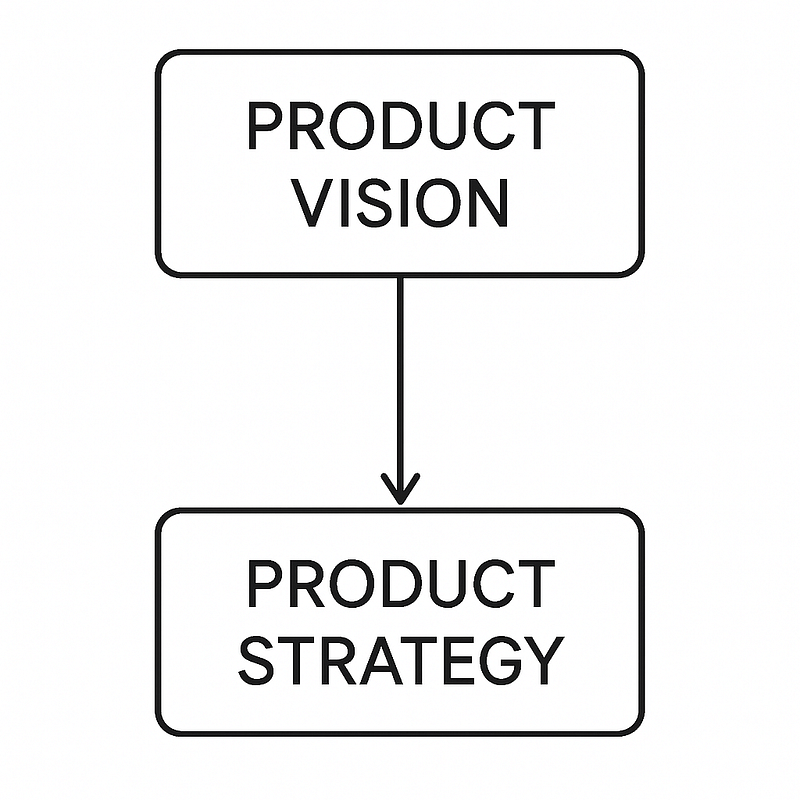
The concepts sound simple, but many product managers struggle to explain them clearly.
Let’s use something everyone can relate to: a weight loss journey.
Vision: The Destination
Imagine you decide to lose 20 kg in one year.
That’s your vision.
It defines where you want to go. It gives you a clear destination and a reason to stay committed when things get difficult.
In product management, a vision serves the same purpose.
A product vision is the long-term aspiration that aligns teams, stakeholders, and leadership around a common future.
A good vision should be:
- Inspiring
- Long-term
- Easy to understand
- Outcome-focused
Think of vision as your North Star.
It tells everyone where you’re headed, even if the path changes along the way.
Strategy: The Roadmap
Once the destination is clear, the next question becomes:
How will you get there?
That’s where strategy comes in.
For our weight loss example, a strategy might look like:
- Consult a dietician
- Run blood tests
- Follow a personalized diet plan
- Exercise regularly
- Track progress every week
- Adjust based on results
In product management, strategy is the high-level plan that connects vision to execution.
While vision defines where you’re going, strategy defines how you’ll get there.
Simple Formula
Vision = Destination
Strategy = Roadmap
From Strategy to Execution: Epics, Features, and Tasks
Great product managers don’t stop at strategy.
They break strategy into actionable work.
Let’s continue our weight loss example.
Epic: Follow the Recommended Diet
Feature: Prepare a healthy chicken salad for lunch
Tasks:
- Chop vegetables
- Boil chicken
- Prepare dressing
- Pack lunch
Epic: Workout Consistently
Feature: Complete today’s chest workout
Tasks:
- Flat bench press
- Push-ups
- Stretching
Epic: Increase Daily Activity
Feature: Daily breathing exercises
Tasks:
- Alom Vilom
- Bhramari
- Deep breathing practice
This decomposition transforms a vision from an abstract goal into something tangible, measurable, and executable.
Metrics Matter
Every strategy needs a feedback mechanism.
Otherwise, you’re operating on assumptions.
For our weight loss journey:
North Star Metric
- Weekly weight loss
- Body fat percentage reduction
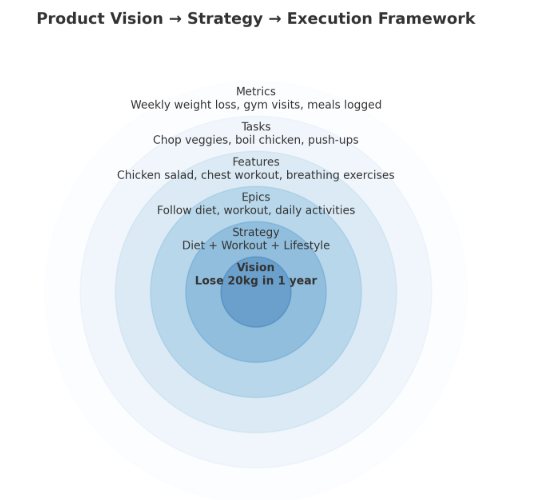
Supporting Metrics
- Number of gym sessions completed
- Percentage of meals followed according to plan
- Daily step count
- Time spent on additional activities
If results aren’t improving, you don’t abandon the vision.
You adjust the strategy.
Maybe the diet changes.
Maybe the workout plan changes.
Maybe recovery needs attention.
The same principle applies to products.
Measure. Learn. Adapt. Repeat.
Reimagining Product Vision and Strategy in the AI Era
AI isn’t just another technology trend.
It’s changing the way products are designed, built, scaled, and experienced.
As product managers, we need to rethink both vision and strategy.
Product Vision in the AI Era
Traditionally, product visions focused on:
- Faster delivery
- Better discovery
- Lower costs
- Better user experiences
Those are still important.
But AI introduces entirely new possibilities.
Modern product visions increasingly focus on:
Augmentation, Not Just Automation
The question is no longer:
“How can we automate this task?”
Instead ask:
“How can we make users smarter, faster, and more capable?”
Personalization at Scale
Every user now expects products to understand:
- Their preferences
- Their behavior
- Their goals
- Their context
AI makes this possible.
Human + AI Collaboration
The future isn’t humans versus AI.
The future is humans working alongside AI.
Modern product visions should define how humans and AI collaborate to achieve better outcomes.
Example
Traditional Vision:
Become the #1 learning platform.
AI-Native Vision:
Empower every learner with an AI tutor that adapts to their pace, learning style, and goals.
Notice the difference.
The second vision is centred on capability enhancement rather than platform dominance.
Product Strategy in the AI Era
Strategy remains the bridge between vision and execution.
However, AI changes what that bridge looks like.
Three major shifts stand out.
1. Data Becomes the Moat
Traditional strategy:
Acquire users → Monetize → Optimize
AI-era strategy:
Acquire users → Capture data → Train models → Build defensibility
The more relevant data you have, the smarter your product becomes.
2. Intelligence Becomes the Differentiator
Traditional products competed through features.
AI products compete through intelligence.
Examples include:
- Recommendations
- Copilots
- Predictive insights
- Auto-completions
- Personalized workflows
The experience becomes the competitive advantage.
3. Trust Becomes a Product Requirement
AI introduces new risks:
- Hallucinations
- Bias
- Privacy concerns
- Regulatory challenges
Modern product strategies must explicitly address:
Transparency
Why did the AI make this recommendation?
Safety
Can this recommendation cause harm?
Compliance
Does it comply with local and global regulations?
Example
Traditional food delivery strategy:
- Add more restaurants
- Reduce delivery times
AI-native strategy:
- Predict cravings before users search
- Optimize delivery routes in real time
- Personalize meal recommendations
- Provide transparent nutrition insights
Same vision.
Completely different strategy.
Reimagining Execution in the AI Era
Execution evolves, too.
Epics
Include:
- Data infrastructure
- AI capabilities
- Model integration
Features
Include:
- AI copilots
- Personalization engines
- Conversational interfaces
Tasks
Now involve:
- Data labeling
- Prompt engineering
- Model evaluation
- Fine-tuning
Metrics
Move beyond traditional product metrics.
Measure:
- Model accuracy
- Hallucination rates
- Trust scores
- User satisfaction
- Bias indicators
The Product Manager Mindset Shift
The role of product managers is evolving.
Yesterday’s PM
- Feature builder
- Roadmap manager
- Delivery coordinator
Tomorrow’s PM
- AI capability orchestrator
- Systems thinker
- Continuous learner
- Ethics-aware decision maker
Customer obsession remains important.
But now it expands to:
Customer + Data + Trust + Ethics
Key Takeaways
Vision = Destination
A clear, inspiring, long-term outcome.
Strategy = The Map
A realistic path to reach the destination.
Execution = The Journey
Breaking work into epics, features, and tasks.
Metrics = Reality Check
Measure progress continuously and adjust when necessary.
AI = Force Multiplier
AI can enhance every stage:
- Smarter vision creation
- Faster strategy development
- Adaptive execution
- Real-time learning loops
Success = Persistence + Adaptation
Whether you’re losing 20 kg or building a product, success comes from consistent effort combined with intelligent course correction.
Closing Thought
In the AI era, product managers can no longer ask only:
What problem am I solving?
They must also ask:
How can AI transform the way this problem is solved—faster, safer, and more personalized than ever before?
The future belongs to product teams that rethink not only what they build, but how they build it.