
The Hidden Discipline Behind Great Product Execution
Product execution is the discipline of how effectively a team delivers on the product vision, roadmap, and priorities — across every stage of the build cycle.
“Product execution” is one of the most critical aspects of product management. It’s about how well you turn product strategy into reality — how you move from ideas, research, and planning to an actual working product that delivers impact.
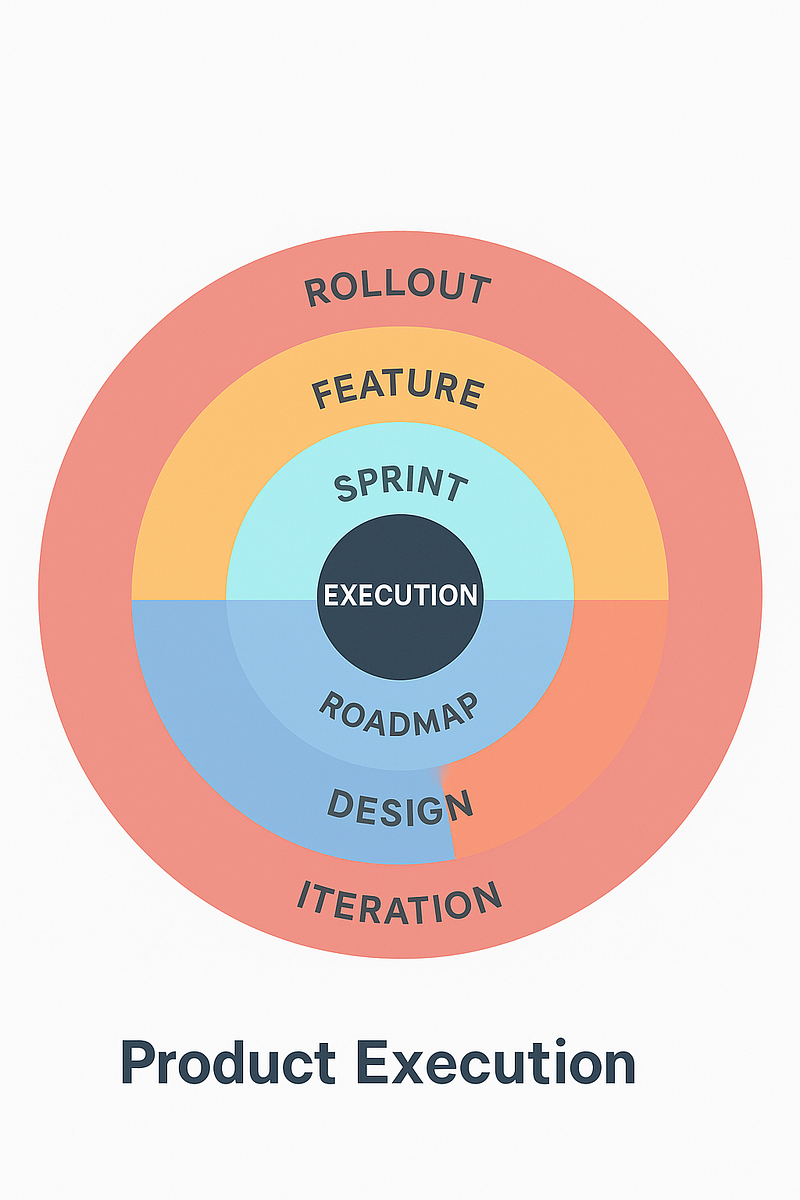
Here’s a breakdown of what product execution usually covers:Most product management books describe execution as a structured process. In reality, execution is often messy, unpredictable, and heavily influenced by organizational dynamics.
This article explores:
- What execution should look like
- What actually happens inside companies
- How strong PMs create order from chaos
🔑 Core Elements of Product Execution (The Textbook Version)
1. Clarity of Goals & Priorities
- Breaking strategy into measurable OKRs and KPIs
- Prioritizing initiatives using frameworks such as:
- RICE
- MoSCoW
- Impact vs Effort
2. Translating Strategy into a Roadmap
- Defining milestones and dependencies
- Sequencing work effectively
- Aligning engineering, design, business, and leadership
3. Spec Writing & Requirements
- Writing PRDs
- User stories
- Acceptance criteria
The goal is to provide enough clarity for teams without over-specifying.
4. Collaboration & Communication
- Sprint planning
- Standups
- Backlog grooming
- Stakeholder updates
5. Execution Monitoring
Tracking progress through:
- Jira
- Asana
- Trello
And proactively identifying risks and blockers.
6. Quality & Delivery
Balancing:
- Speed
- Quality
- Scalability
- Technical debt
While ensuring proper QA and UAT.
7. Post-Launch Iteration
After launch, teams should:
- Track adoption
- Measure usage
- Gather customer feedback
- Iterate rapidly
📊 Metrics That Measure Execution Quality
Velocity
Stories completed per sprint.
Predictability
Planned vs delivered work.
Cycle Time
Time taken from idea to release.
Quality
- Bugs reported after launch
- Uptime
- Incidents
Impact
Movement in:
- Retention
- Conversion
- Revenue
- OKRs
🚦 Product Execution: Ideal vs Reality
The textbook version sounds great.
The reality inside startups, scale-ups, and large enterprises is often very different.
1. Clarity of Goals & Priorities
Ideal
- Data-driven prioritization
- RICE scoring
- OKR alignment
Reality
Priorities shift because:
- The CEO requests something urgent
- A large customer threatens to churn
- Leadership changes direction
PMs spend more time managing changing priorities than scoring features.
2. Translating Strategy Into a Roadmap
Ideal
Roadmaps align perfectly with company strategy.
Reality
Roadmaps often become wishlists.
Business urgency creates constant detours:
- Sales opportunities
- Fundraising commitments
- Partner demands
The roadmap becomes a moving target.
3. Spec Writing & Requirements
Ideal
- Detailed PRDs
- Clear acceptance criteria
- Stakeholder sign-off
Reality
Many features are shipped based on:
- Slack messages
- Whiteboard sketches
- Verbal discussions
Sometimes documentation is written after the feature ships.
4. Collaboration & Communication
Ideal
Continuous alignment and proactive communication.
Reality
Communication often happens after surprises appear.
Many teams unintentionally follow:
Build first. Explain later.
5. Execution Monitoring
Ideal
PMs monitor:
- Velocity
- Burndown
- Risks
- Blockers
In real time.
Reality
Execution frequently runs on assumptions and trust.
Most PMs spend more time firefighting than monitoring.
6. Quality & Delivery
Ideal
- Thorough QA
- UAT
- Regression testing
Reality
Many teams operate with:
Better live than late.
Which leads to:
- Bugs in production
- Reactive fixes
- Technical debt accumulation
7. Post-Launch Iteration
Ideal
- Tracking defined before launch
- Analytics ready
- Success metrics agreed
Reality
Tracking often gets added after launch.
The team discovers adoption problems weeks later.
🔑 Why This Happens
Most execution problems come from:
Constant Priority Changes
Leadership and customer-driven shifts.
Resource Constraints
Limited PM, engineering, design, and QA bandwidth.
Overconfidence
“We already know what users want.”
Reactive Culture
Business-driven rather than product-driven decisions.
Speed Pressure
Shipping becomes more important than clarity.
🧭 How Great PMs Stand Out
Great PMs don’t eliminate chaos.
They create guardrails around it.
1. Protect Critical Decisions
Never skip:
- Problem definition
- Success metrics
- Trade-offs
2. Overcommunicate at Decision Points
Especially when:
- Scope changes
- Priorities shift
- Launch risks emerge
3. Use Lightweight Documentation
Instead of a 10-page PRD:
Use a 1-page document
- Problem
- Goal
- Must-haves
- Success metric
4. Bake Tracking Into Definition of Done
Every release should include analytics instrumentation.
No exceptions.
5. Push Back With Trade-Offs
Instead of saying:
Yes, we can do that.
Say:
If we prioritize this request, Feature X slips by two weeks and Revenue Opportunity Y gets delayed.
This changes conversations dramatically.
🎯 Simplified Definition
Product Execution = How well we do what we said we would do.
It is not about strategy slides.
It is about delivering outcomes through disciplined execution.
📘 What PM Books Say vs What Happens in Real Life
Execution is not owned by the PM alone.
It is a collective output involving:
- Product
- Engineering
- Design
- QA
- Operations
- Sales
- Marketing
The PM is the orchestrator.
Execution Happens Across Multiple Layers
Roadmap Execution
Are we delivering what we committed?
Sprint Execution
Are we delivering each sprint predictably?
Feature Execution
Idea → PRD → Design → Development → QA → Launch → Tracking
Design Execution
Is the intended experience making it into production?
Rollout Execution
Launch readiness, communication, and enablement.
Iteration Execution
Learning and improving after launch.
🔄 The Product Execution Deadlock Loop
Step 1
A new feature is prioritized.
Step 2
A previous feature underperforms.
Step 3
Stakeholders escalate concerns.
Step 4
The PM splits focus.
Step 5
The current project suffers.
Step 6
Leadership forces delivery.
Step 7
A half-ready feature launches.
Step 8
The cycle repeats.
And everyone wonders why execution quality keeps declining.
🎯 Why This Loop Exists
Common root causes include:
- No stabilization period after launch
- No adoption buffer in planning
- Stakeholders expecting linear outcomes
- Leadership pressure overriding process
🛠️ Breaking the Loop
Stabilization Sprint
Reserve capacity after every major release.
Transparent Risk Logs
Document trade-offs and risks visibly.
Adoption Success Gates
Features are not “done” until users actually adopt them.
Leadership Protection
Product leaders must shield teams from last-minute chaos.
Risk-Based Narrative
Translate execution risks into business risks.
🎯 Practical Actions PMs Can Start This Week
Build an Execution Health Dashboard
Track:
- Roadmap commitments vs delivered
- Sprint predictability
- Cycle time
- Scope changes
- QA coverage
- Analytics readiness
Maintain a Trade-Off Log
Document:
- Request
- Requester
- Impact
- Approved trade-off
Make Definition of Done Non-Negotiable
Every release must include:
- Analytics
- UAT
- Rollout plan
- Release checklist
Run Blameless Postmortems
Focus on:
- Process
- Systems
- Root causes
Not blame.
Use Pre-Mortems
Before risky initiatives:
Ask:
What could fail?
Before it actually does.
Push Back With Data
Replace opinions with quantified trade-offs.
Create Guardrails
Examples:
- No major scope changes mid-sprint
- Critical requests require leadership approval
⚡ Why Leaders Focus on Outcomes
Leaders ultimately care about:
✅ Did it ship?
✅ Did it move metrics?
Because those are the outcomes visible to the business.
Execution details matter, but outcomes determine success.
🧠 The Real Insight
Most execution failures are not individual failures.
They are system design failures.
Strong PMs understand this.
Exceptional PMs make those systems visible and improve them.
Final Takeaway
Product execution is messy.
The goal isn’t to eliminate chaos.
The goal is to create enough structure that teams can consistently deliver outcomes despite the chaos.
At the end of the day, great PMs master two things simultaneously:
Managing the messy reality
and
Delivering measurable outcomes
That’s what separates good product managers from great ones.