
How Great Product Managers Use AI to Build Better Products
This article is a practical guide for PMs at all levels — from aspiring newcomers to seasoned product leaders.
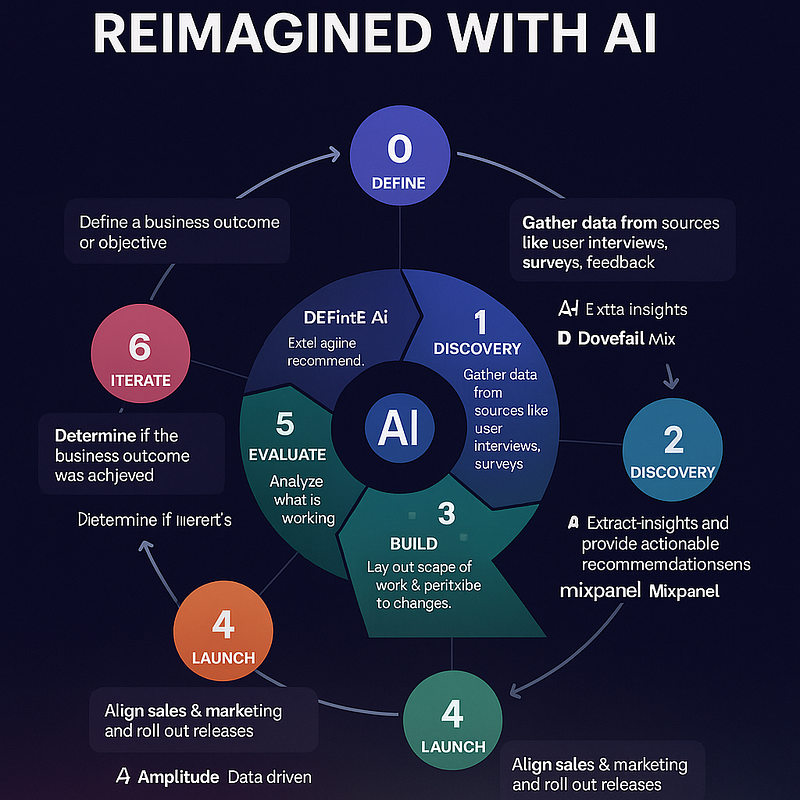
As the responsibilities of product managers (PMs) evolve in a rapidly changing tech world, Artificial Intelligence (AI) is emerging as a transformative force. PMs today are no longer just idea validators and requirement writers; they are outcome-driven strategists. But with the rise of AI, each phase of the product management lifecycle can now be enhanced to deliver quicker results, deeper insights, and more significant business impact.
You’ll learn:
- What PMs traditionally do at each stage
- How AI makes the process smarter and more efficient
- Specific AI tools that boost effectiveness
- Real-world working examples of each tool
- Visual frameworks to connect all phases
Let’s break it down.
Product Management Lifecycle: A Quick Visual
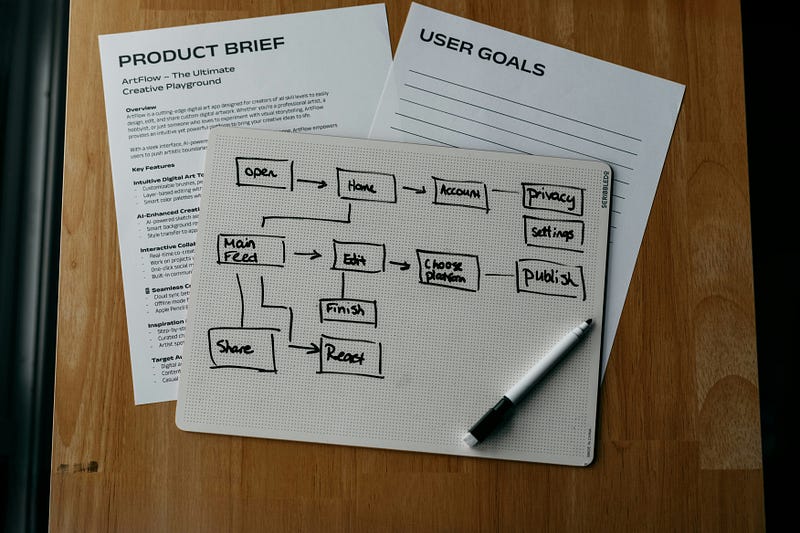
Phase 0 - Define Business Objective
Phase 1 - Discovery
Phase 2 - Validation
Phase 3 - Build
Phase 4 - Launch
Phase 5 - Evaluate
Phase 6 - Iterate
Each phase is supported by AI-enabled tools that help PMs make better, faster decisions.
Phase 0: Define Business Objective
Traditional PM Approach:
Align with stakeholders and leadership.
Analyze OKRs, past KPIs, and market trends.
AI-Enhanced Workflow:
AI synthesizes business data and historical KPIs to surface the most impactful objectives.
AI Contributions:
Ingests past OKRs, company performance reports.
Suggests goal alignment based on revenue, retention, or adoption trends.
Simulates potential business outcomes using forecasting models.
AI Tools:
- Notion AI / ChatGPT Enterprise: Generate goal hypotheses.
- Tableau AI / Power BI Copilot: KPI alignment visualization.
Working Example:
PM uploads past OKRs and quarterly business results into ChatGPT Enterprise and gets 3 prioritized objectives backed by historical success rate and predicted ROI.
Outcome:
Faster, evidence-based business alignment.
Phase 1: Discovery
Traditional PM Approach:
Collect support tickets, conduct interviews, analyze NPS manually.
Review call transcripts and log product usage.
AI-Enhanced Workflow:
AI makes sense of multi-source data, finds patterns, and pinpoints validated problems.
AI Contributions:
Analyzes qualitative and quantitative data.
Summarizes user feedback from calls, tickets, and surveys.
Recommends most common and painful user issues.
AI Tools:
- Dovetail AI: Transcripts, tagging, insight generation.
- Fireflies.ai / Grain.ai: AI-generated call insights.
- Productboard AI: Feedback clustering, prioritization.
Working Example:
Grain.ai processes 100 sales/support calls, and Dovetail surfaces “checkout flow confusion” as a major issue. Productboard shows it is linked to $50K in lost sales.
Outcome:
More comprehensive discovery with multi-perspective clarity.
Phase 2: Validation
Traditional PM Approach:
Build prototypes manually.
Conduct interviews, A/B tests, and surveys.
Time-consuming iteration loops.
AI-Enhanced Workflow:
Validate faster with predictive modelling, synthetic feedback, and instant prototyping.
AI Contributions:
Prototype UI with natural language prompts.
Predict adoption and engagement.
Generate survey questions based on problem hypothesis.
AI Tools:
- Uizard / Figma AI / Framer AI: Design mockups quickly.
- Maze + AI Insights: Run usability tests with AI summary.
- PlaybookUX: Automates user feedback analysis.
Working Example:
PM uses Uizard to create three UI variations in 10 minutes. Maze reveals that one variant yields 30% higher task completion with fewer misclicks.
Outcome:
Quick go/no-go decision backed by data.
Phase 3: Build
Traditional PM Approach:
Write user stories, PRDs, and acceptance criteria.
Coordinate across engineering, QA, and design.
Map scope manually and often face last-minute changes.
AI-Enhanced Workflow:
AI drafts stories, maps tech dependencies, and suggests tests.
AI Contributions:
Autogenerates documentation (PRDs, user stories, acceptance criteria).
Predicts impact on codebase.
Suggests roadmap adjustments in real-time.
AI Tools:
- Jira + Atlassian Intelligence: Ticket generation.
- CodiumAI / GitHub Copilot: Code change analysis and test writing.
- Craft.io + AI Roadmap Engine: Dynamic roadmap updates.
Working Example:
Craft.io generates PRD from problem statement. CodiumAI identifies 2 areas of code affected by new login flow and suggests tests before build starts.
Outcome:
Faster dev planning reduces the risk of scope creep.
Phase 4: Launch
Traditional PM Approach:
Manually plan feature rollouts.
Schedule announcements and create release notes.
Low visibility into live metrics post-release.
AI-Enhanced Workflow:
Smart, usage-triggered releases with automatic tracking.
AI Contributions:
Suggests the best timing based on usage patterns.
Segment users for release cohorts.
Generates dashboards for launch tracking.
AI Tools:
- LaunchDarkly + AI: Smart rollouts.
- Pendo / WalkMe: In-app announcements.
- Amplitude AI / Heap: Post-launch behaviour analytics.
Working Example:
LaunchDarkly rolls out “saved search” to only power users. Amplitude shows 45% usage within a week. Pendo in-app guide increases adoption 2x.
Outcome:
Smarter launches, immediate feedback loops.
Phase 5: Evaluate
Traditional PM Approach:
Pull analytics reports manually.
Connect feedback to specific features.
Identifying issues too late.
AI-Enhanced Workflow:
AI pinpoints what worked and what didn’t, in near real-time.
AI Contributions:
Tracks feature-level usage anomalies.
Cluster tickets related to new features.
Generates optimization suggestions.
AI Tools:
- Hotjar AI: Session heatmaps + behavioural patterns.
- Mixpanel AI / Amplitude AI: Feature usage impact.
- Zendesk AI: Ticket tagging and sentiment analysis.
Working Example:
Hotjar shows a low scroll rate in the new dashboard UI. Mixpanel reveals a churn spike. Zendesk AI flags recurring complaints around “filter logic”.
Outcome:
Proactive evaluation and optimization readiness.
Phase 6: Iterate
Traditional PM Approach:
Repeat discovery and validation manually.
Long product update cycles.
AI-Enhanced Workflow:
Feedback > Insight > Prototype > Test — all in days.
AI Contributions:
Auto-generates ideas based on gaps.
Predicts potential uplift in KPIs.
Suggests next iteration paths.
AI Tools:
- Canny + AI Prioritizer: Suggest top enhancements.
- ChatGPT + Custom GPTs: Draft improved features.
- Figma AI + Maze: Iterate and retest fast.
Working Example:
Canny shows that top enterprise customers want Excel export. ChatGPT drafts an enhancement document. Figma AI builds a wireframe in an hour.
Outcome:
Lean, user-driven product iteration cycle.
🔬 Final Takeaway: AI Empowers Outcome-Focused PMs
PMs no longer need to spend hours synthesising feedback, writing specs, and running manual analysis. With AI, you can:
Deliver product value faster
Build better customer experiences
Focus on outcomes, not just outputs
Whether you’re a solo PM at a startup or leading a platform at a Fortune 500 company, now is the time to incorporate AI into your PM toolkit. This is not just the future of product management. It’s the present.