
Why Pricing Is One of the Most Powerful Product Decisions
Pricing is not random. It’s one of the most calculated product decisions, shaped by customer behaviour, competition, costs, and strategy. Let’s dive in with examples.
We often see price changes in our daily lives — a new ₹14 Swiggy platform fee, Netflix increasing its subscription, or an iPhone costing ₹20,000 more every year. But have you ever wondered: how do companies decide these numbers? Why not ₹13 or ₹15 instead of ₹14?
🔑 General Factors That Influence Pricing
Regardless of industry or model, pricing decisions usually depend on:
Customer willingness to pay (WTP): How much value customers perceive vs. alternatives.
Competition pricing: Benchmarking against direct and indirect competitors.
Cost structure: COGS (Cost of Goods Sold), operational costs, margin expectations.
Market demand vs. supply: Scarcity or surplus shifts power.
Positioning: Premium vs. mass-market brand identity.
Elasticity: Sensitivity of demand to price changes.
Customer lifetime value (LTV): Higher LTV justifies upfront losses or freemium models.
🏢 Different Business Models & Pricing Strategies
1. B2B (Business-to-Business)
Characteristics: Longer sales cycle, fewer but larger accounts, decision by multiple stakeholders (procurement, finance, tech).
Pricing Models:
- Value-based pricing (ROI-driven, e.g., “our tool saves you $1M/year, so we charge $200k”).
- Tiered contracts (based on scale/volume).
- Custom/negotiated pricing.
Example: Salesforce selling CRM — price depends on seats, features, and enterprise scale.
2. B2C (Business-to-Consumer)
Characteristics: Large customer base, high price sensitivity, faster purchase decisions.
Pricing Models:
- Competitive pricing (matching or slightly undercutting competitors).
- Psychological pricing ($99 instead of $100).
- Freemium (basic free plan, paid upgrades).
- Bundling & discounts.
Examples are Netflix subscription tiers, Zomato Gold, and Amazon Prime.
3. D2C (Direct-to-Consumer)
Characteristics: Own distribution channel (website, app, offline store), brand-driven, focus on loyalty and repeat purchases.
Pricing Models:
- Premium branding (Apple iPhone — margin heavy).
- Penetration pricing (new D2C brands like Mamaearth enter low to gain traction).
- Subscription for consumables (beard oils, protein powders).
Example: Boat earphones — started with competitive/discount-led pricing, now moving to premium.
4. B2B2C (Business-to-Business-to-Consumer)
Characteristics: Sell to businesses, but end users are consumers (depends on partner adoption).
Pricing Models:
- Revenue-share (Stripe takes % per transaction).
- Per-seat/per-user pricing (Slack via enterprise).
- API call-based (Twilio, Exotel).
Example: Dunnhumby (helps retailers with insights → final value reaches consumers indirectly).
5. SaaS (Software-as-a-Service)
Characteristics: Scalable, recurring revenue, high gross margins, and customer retention are key.
Pricing Models:
- Per-user/per-seat (Slack, Zoom).
- Usage-based (AWS: pay for compute/storage).
- Feature-based tiers (Basic, Pro, Enterprise).
- Freemium + upsell.
Example: HubSpot — free CRM but upsells Marketing Hub, Sales Hub.
6. Service Industry (Consulting, Logistics, Agencies, Healthcare, etc.)
Characteristics: Intangible value, highly dependent on expertise, trust, and customisation.
Pricing Models:
- Hourly/daily rates (lawyers, consultants).
- Retainer (agencies keep clients on fixed monthly).
- Value/outcome-based (McKinsey charges based on impact delivered).
- Pay-per-use (logistics, Uber, food delivery).
📊 How Product Managers Approach Pricing
Market research: Competitive analysis, customer interviews, A/B testing.
Segmentation: Different tiers for different personas (small biz vs enterprise).
Experimentation: Test discounts, bundles, and freemium conversion rates.
Financial modelling: Balance CAC (Customer Acquisition Cost), LTV, and margins.
Continuous iteration: Pricing is never final — PMs adjust with market shifts.

✅ In short:
- B2B → ROI, contracts, negotiated pricing.
- B2C → Volume, psychology, competitive benchmarking.
- D2C → Brand-driven, penetration/premium.
- B2B2C → API/revenue share, per-user.
- SaaS → Subscription, tiered, usage-based.
- Services → Hourly, retainer, outcome-based.
🥡 Example 1: Swiggy’s Platform Fee — From ₹12 to ₹14
Do you know why Swiggy quietly increased its platform fee by ₹2 recently?
Let’s break it down:
Swiggy processes ~2.5 million orders daily.
An increase of just ₹2 → ₹5 crore extra per day → ~₹1,500 crore extra annually.
For you and me, ₹2 feels negligible (that’s psychological pricing: small enough not to hurt). But for Swiggy, this is massive revenue without changing operations.
Why did they do it?
Rising costs → fuel, delivery executive payouts, restaurant commissions.
Profitability pressure → investors push for margin improvements.
Price sensitivity testing → They likely ran A/B tests: some users saw ₹12, others ₹14. If drop-off was negligible → rollout at scale.
👉 Analogy: Imagine you run a coaching class with 2,000 students. If you increase fees by ₹100/month, you earn ₹2,00,000 more. Most students won’t quit for ₹100, but your business margin shoots up. That’s how Swiggy thinks.
🏠 Example 2:D2C Pricing Strategy in Household Services (Detailed Example)
Most of us in metro cities know the pain of finding reliable household help — cooking, cleaning, mopping, dishwashing. Startups are trying to “productize” this unorganised market by offering on-demand domestic services.
But here’s the big question:
👉 Why does a 1-hour service cost ₹149, while an 8-hour service costs ₹649?
👉 And how should a company decide whether short gigs or full-day jobs are more profitable?
Let’s break this down like a product manager would.
⚖️ Step 1: Understand the Cost Structure
A domestic help worker’s daily earning potential in an unorganised setup is ₹500–₹1200 for 8 hours.
Now, if a startup wants to formalise this, additional costs kick in:
- Worker wages (baseline ₹500–1200/day).
- Training cost → ~₹15,000–20,000 for a 3-day workshop, trainers (2–3), training centre rentals. Spread across ~30 workers → ~₹600–800 per worker.
- Tech & infra cost → App development, support, office space.
- Compliance & taxes → GST, PF/ESI if formal employment.
So, the company cannot charge too low, or else margins vanish.
📍 Step 2: City Benchmarking
Reality check: what’s the local market rate?
- Mumbai: ₹2500/month (≈ ₹80/day for 1 hr/day help).
- Delhi: ₹1800/month (≈ ₹60/day).
- Bangalore: ₹3000/month (≈ ₹100/day).
- Kolkata: ₹1200/month (≈ ₹40/day).
👉 Customers are already anchored to these numbers. If a startup charges ₹149/hour, customers will ask, “Why pay 2.5X for what I get cheaper every month?”
The startup must, therefore, differentiate in terms of reliability, convenience, hygiene, and background verification.
🧪 Step 3: Pricing Hypothesis Testing
Here’s how a PM would test pricing hypotheses in metros:
- Run A/B Tests by Micro-Markets
Charge ₹129/hour in one locality, ₹149 in another, ₹169 in a third.
Measure conversion, repeat rate, churn.
2. Segment Customers by Urgency & Affluence
Urgent booking → Premium pricing (just like Uber surge).
Pre-scheduled help → Lower pricing.
3. Test Packaged Pricing
Single job = ₹149/hour.
10-hour prepaid pack = ₹129/hour.
Full-day = flat ₹649.
👉 This way, you test elasticity → how sensitive customers are to ₹20–30 differences.
⏳ Step 4: Which Duration Makes More Money?
Let’s run a quick unit economics example for a single worker.
Option A: 1-Hour Jobs
- A worker can handle ~5 jobs/day (considering travel + gaps).
- Revenue per job = ₹149.
- Daily revenue = 5 × 149 = ₹745.
- Worker payout (say ₹500/day min) → Company margin ≈ ₹245/day.
- BUT → High logistics cost (travel, scheduling, cancellations).
Option B: 8-Hour Full Day
- Revenue = ₹649/day.
- Worker payout = ₹500/day.
- Company margin ≈ ₹149/day.
- BUT → Lower coordination overhead, predictable usage.
👉 Insight:
Short jobs (1-hr) = higher revenue potential, but ops-heavy.
Full-day jobs (8-hr) = lower revenue per worker, but stable and scalable.
So the company must decide its strategy:
Go after affluent, time-starved metros → push short jobs (higher willingness to pay).
Go after price-sensitive Tier 2/3 → push full-day or monthly packages (higher stickiness).
🎯 Step 5: Strategy for Metro Pricing
- Mumbai/Bangalore (high affluence, high maid cost):
Push 1-hour jobs at ₹149–169.
Customers compare against ₹80/day maids, but pay extra for reliability & hygiene.
2. Delhi/Kolkata (lower base rates):
Push 8-hour/day plans at ₹649 or monthly subscriptions.
Lower resistance since maids are cheaper, but daily full-time help is harder to get.
3. Tier 2/3 Cities (future expansion):
Subscription packs → “Unlimited help for ₹X/month.”
Compete with unorganized sector by offering trust & quality.
How Pricing Strategy Fuels Monetisation?
Pricing and monetization have a strong symbiotic correlation: pricing is a critical component of a broader monetization strategy, as it directly influences how much value is perceived and how revenue is captured. A successful monetization strategy integrates pricing decisions with the product’s value, target market, and overall business goals to drive revenue and profitability.
Pricing as part of Monetization
Beyond just the numbers:
Monetization is a holistic approach that includes understanding core use cases, choosing a revenue model (like subscription or freemium), defining value metrics, and determining the costs of delivery.
Communicating value:
Pricing acts as a powerful communication tool, signalling the product’s quality and value to customers. A strategically set price can enhance or diminish perceived value.
🔑 How Monetization Works in Household Services (D2C Model)
At its core, monetization = what the customer pays — what it costs you to deliver the service.
Here are the components:
1. Revenue Side (Customer Payments)
- Hourly Charges: ₹149–₹649 depending on duration (1 hr, 4 hr, 8 hr).
- Subscription / Monthly Plans: Like “₹3,999/month for daily cleaning (1 hr per day)”.
- Premium Add-ons: Deep cleaning, sanitization, festive cleaning, etc.
- Surge Pricing: Higher rates during weekends, festivals, or high-demand slots.
👉 Example: A customer books a 4-hr maid at ₹449. That’s direct revenue.
2. Cost Side (What You Spend to Deliver)
- Worker Payout: Minimum ₹500–₹1200/day (market wage benchmark).
- Training Cost: Trainers (₹15–20k each) + centre infra. Spread across workers trained (say ₹500–₹700 per worker, one-time).
- Tech Cost: App development, booking system, GPS tracking, and payment gateway fees.
- Operational Cost: Staff salaries, office rent, and customer support.
- Govt Taxes & Compliance: GST, PF/ESIC if full-time workers are employed.
👉 Example: For that ₹449 booking, maybe you pay ₹300 to the worker, add ₹50 ops cost, and ₹20 tech/tax overhead = ₹370 cost.
Profit = ₹449 — ₹370 = ₹79 per booking (≈18% margin).
3. Unit Economics by Duration
- 1-hr job @ ₹149 → Worker gets ~₹100. After ops, the margin might be just ₹10–₹15. Low margin, but high frequency possible.
- 4-hr job @ ₹449 → Worker gets ~₹300. Margin ~₹70–₹100. Better balance.
- 8-hr job @ ₹649 → Worker gets ~₹500–₹550. Margin ~₹80–₹100, but the worker is locked for the full day (fewer bookings).
👉 This is why 4-hr jobs may give the healthiest unit economics — good customer pricing + efficient worker utilisation.
4. Scalability of Monetization
- More Workers = More Bookings = More Revenue.
- But, if too many workers sit idle → costs rise faster than revenue.
- Hence, you test city by city with different price points (Mumbai vs Delhi vs Bangalore vs Kolkata).
👉 Example:
In Mumbai, if local maid costs ₹2500/month (~₹83/day), your pricing of ₹649/day looks premium (must justify with quality & reliability).
In Bangalore, where maids cost ₹3000/month (₹100/day), still premium but demand may be higher due to working professionals.
✅ Monetization Formula =
(Total Customer Payment per Booking × Number of Bookings) — (Worker Payout + Training Cost per Worker + Ops + Tech + Taxes).
Here’s a simple visualization of how monetization works in household services:
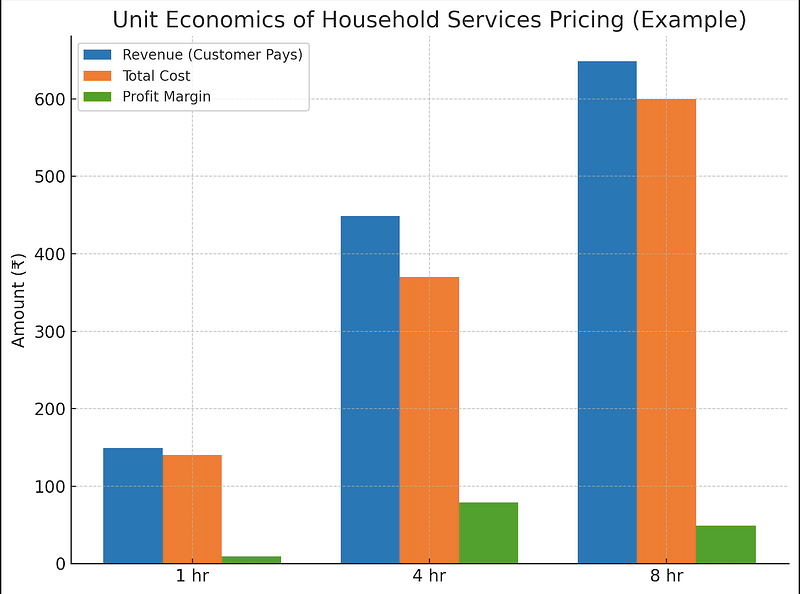
- Revenue: What the customer pays (₹149, ₹449, ₹649).
- Total Cost: Worker payout + operational costs + tech & tax.
- Profit Margin: Difference between revenue and cost.
👉 From the chart, shorter jobs (1 hr) give higher margins per hour but need more bookings; longer jobs (8 hrs) give stable revenue but thinner margins.
🚀 The Takeaway: Deciding pricing for household services is not just about “covering costs.” It’s about:
Worker earnings vs company margins.
Customer perception vs market benchmarks.
Short jobs vs full-day gigs tradeoff.
City-level differences in willingness to pay.
How each pricing model shapes monetization.
👉 The ₹149/hour vs ₹649/day question is not about numbers alone. It’s about choosing between volume-driven monetization (higher frequency of short jobs, smaller margins) vs predictability-driven monetization (full-day bookings, fewer but larger transactions).
💡 In other words, monetization strategy is baked into the pricing choice itself:
Hourly rates maximize customer acquisition & repeat usage.
Day-rates maximize ARPU (average revenue per user) & unit economics stability.
This is how real-world D2C monetization works — a continuous cycle of pricing → monetization impact → test → iterate.
“While pricing is about setting the specific cost for a product or service, monetization encompasses the entire system of how value is exchanged for revenue. A thoughtful pricing strategy is foundational to any successful monetization plan, ensuring that the price reflects the true value delivered and captures it efficiently”